
Phone’s ringing. Hands full.
Missed calls add up.
Put in your calls a week, the share you answer and your average job. Move the assumptions and see the revenue that could be at risk. It is an estimate, not a measurement of your shop.

Three numbers you know.
What the missed ones cost.
Everything else is worked out in the open, and both assumptions are sliders you can move.
Your assumptions
Move these if your shop runs differently. The number follows.
Estimated revenue at risk
$7,820a month
$93,840 a year
One week on your line31 answered · 14 missed
- 61
- missed a month
- 46
- never call back
- 23
- potential jobs missed
What this means
Under these assumptions, 23 potential jobs at $340 is $7,820 a month in revenue, not profit. It is an estimate, not a claim about results from OnSiteCall.
No hidden multiplier.
Here is exactly what it did.
Five steps, in order, with both judgment calls named.
- Calls a week, minus the share you answermissed calls a week
- Times 4.33, the weeks in an average monthmissed calls a month
- Times the share who ring the next shop insteadcallers who never return
- Times the share who would have bookedpotential jobs missed
- Times your average jobrevenue at risk
75% assumed not to call back
An editable example, not an industry statistic. Replace it with what you see when you return calls.
50% assumed to book
Another editable example, not a measured conversion rate. It assumes half of the callers who never came back would have become jobs.
Revenue, not profit
The answer is invoice totals at risk, before parts and labor. It is the size of the leak, not what would land in your pocket.
What it can’t know. This is arithmetic, not a forecast. It cannot know your market, your close rate or your season, so treat it as the shape of the leak rather than a promise. It does not describe results from OnSiteCall.
When you can’t pick up.
Give them another way in.
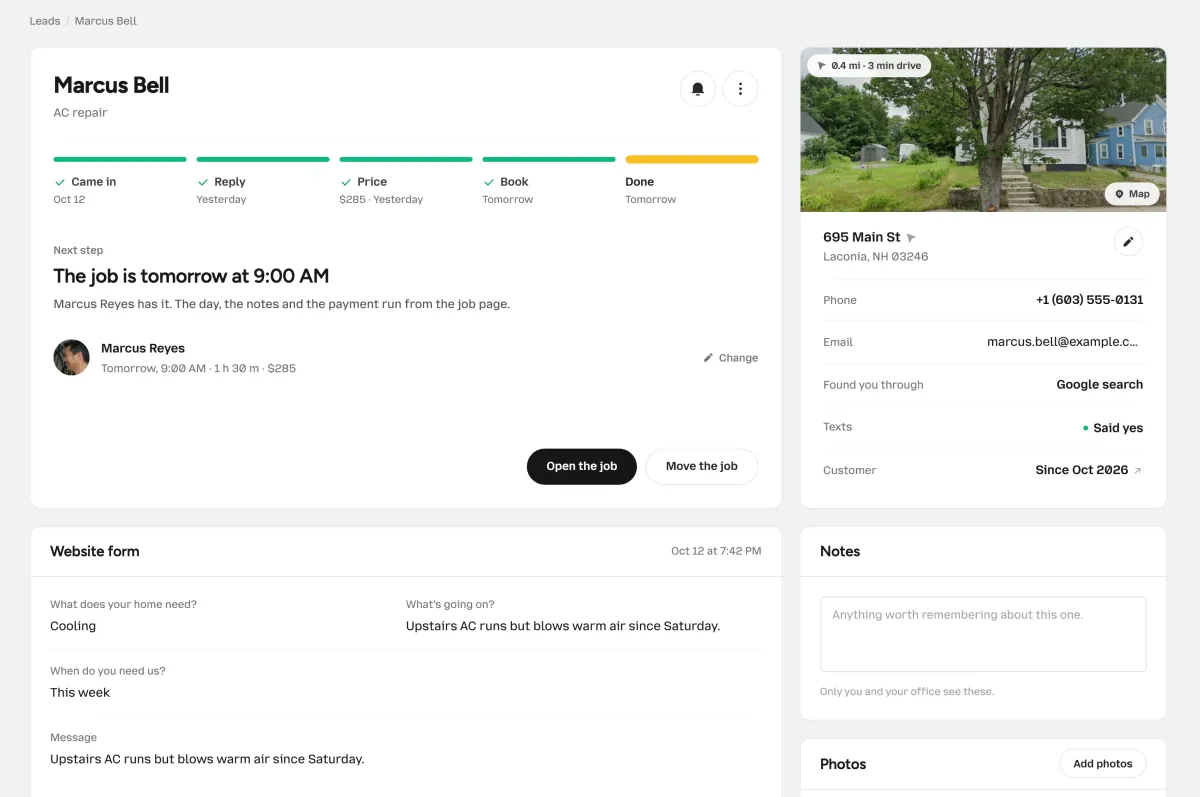
Calls still ring your own phone. Your website form and chat take the job details when you can’t pick up, and you text back from your business number when you can.
Lead forms on your own website
Website chat that answers from your details
Texts from your business number
Questions about the missed call calculator.
The ones a skeptical owner asks, answered straight.
Where do the default assumptions come from?
They are editable examples, not survey results or measured industry averages. Put in your own numbers and the estimate follows.
Does a missed call really cost a whole job?
Not every one. That is what the two assumption sliders are for: they narrow the missed calls down to the people who never called back, then to the ones who would have booked.
What counts as a missed call?
Any call where nobody spoke to the caller: it rang out, went to voicemail, or sat on hold until they gave up. Robocalls are not worth counting.
What can I actually do about the misses?
Set a callback routine, arrange cover during busy hours, record a greeting that tells callers when you will call back, and give customers another way to reach you, such as a website form. This calculator does not answer calls or predict the results of any service.
Is anything I type here saved?
No. It runs in your browser, there is no account and nothing is sent anywhere. Close the tab and it is gone.
Another way in.
Keep the next inquiry moving.
See how website leads connect to estimates, jobs and invoices.
Try it free for 15 days. No credit card required.